The label, read closely
Sodatide Formula and Label: Two Fibers, Three Bacteria, Some Blanks
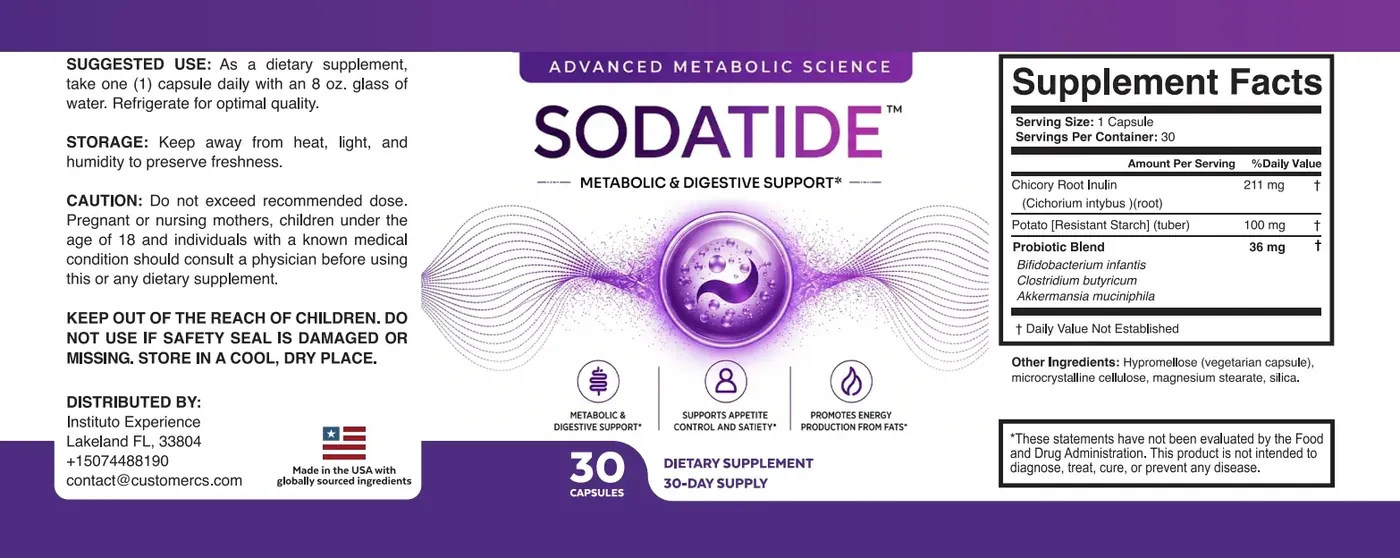
Sodatide's formula packs two fibers and three bacteria into one capsule: chicory root inulin at 211 mg, potato resistant starch at 100 mg and a 36 mg probiotic blend. The label leaves blank the live count, strain codes, live-or-pasteurized status, factory name and lot number.
Written by the Sodatide editorial team · Medically reviewed by Dr. Sejal Desai, MD, PhysicianPublished · Last updated · Reviewed · 9 min read
At a glance
Key facts
- A serving is one capsule, and a bottle contains 30.
- The Supplement Facts show 211 mg of chicory root inulin, 100 mg of potato resistant starch and a 36 mg probiotic blend, none with an established Daily Value.
- Fiber totals 311 mg, and all three actives together come to 347 mg.
- Blank on the label: live count (CFU), strain codes, amount per strain, live or pasteurized, factory name, lot number and best-before date.
- The fibers amount to about 2 to 4 percent of the gram doses used in studies.
- A supplement, not FDA approved, with no study of its own and no link to GLP-1 drugs.
What does the front of the Sodatide label claim?
Three things, each with an asterisk, and none of them tested on this capsule.
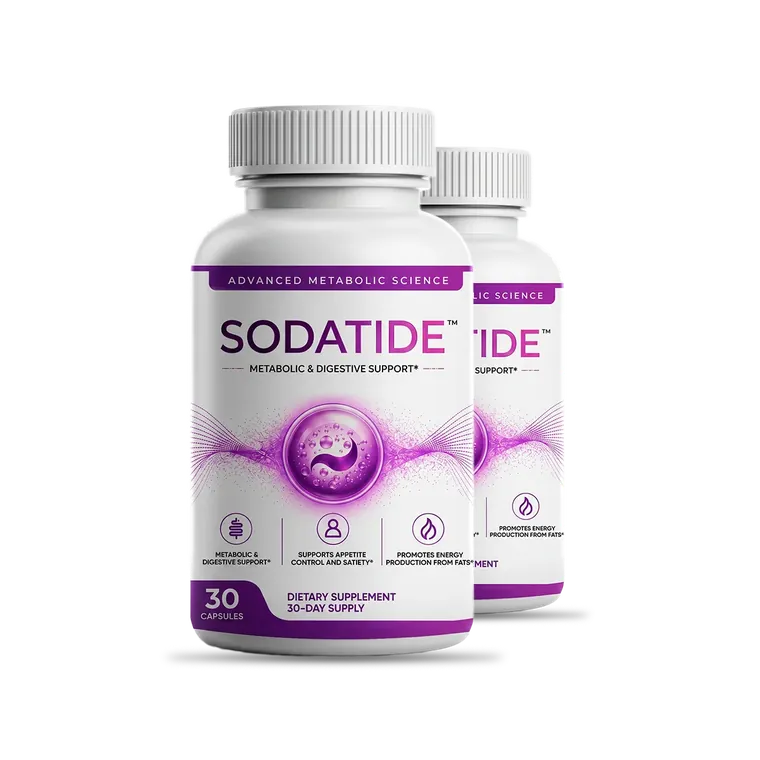
They read Metabolic and Digestive Support, Supports Appetite Control and Satiety, and Promotes Energy Production From Fats. Underneath sit 30 Capsules, Dietary Supplement and 30-Day Supply.
Each asterisk leads to the standard FDA line: these statements have not been evaluated, and the product is not intended to diagnose, treat, cure or prevent any disease. That line is required alongside this kind of claim (21 CFR 101.93 (disclaimer, disease claims)).
Look at what the front leaves out: weight loss, blood sugar and clinically proven are all absent. The sales page adds more, yet the label is the more careful document.
What is in the Supplement Facts panel?
| Panel line | Amount | Share of 347 mg | Daily Value |
|---|---|---|---|
| Chicory root inulin | 211 mg | About 61% | Not established |
| Potato resistant starch | 100 mg | About 29% | Not established |
| Probiotic blend (3 species) | 36 mg | About 10% | Not established |
| Live count (CFU) | Not published | Not published | Not applicable |
Below the panel come hypromellose, microcrystalline cellulose, magnesium stearate and silica. Hypromellose is the shell; the rest are helpers.
The panel speaks clearly about the fibers and vaguely about the bacteria. That split is the key to reading this label.
The whole label is public, so read it firstOne capsule a day, adults only, and the sales page states a 60-day money-back window.
See today's price and guaranteeDisclosure: Sodatideroutine earns a commission when you order through this site's links. Sodatide is a dietary supplement. It is not FDA approved.
How big is the fiber dose compared with the studies?
Small. Fiber trials dosed in grams a day, and Sodatide doses in milligrams.
| Ingredient | On the label | Study dose | Share |
|---|---|---|---|
| Chicory root inulin | 211 mg | 10 g a day for 8 weeks (Jackson 1999 (inulin 10 g/day)) | About 2.1% |
| Potato resistant starch | 100 mg | 3.5 g a day, lowest prebiotic dose (Bush 2023 (resistant potato starch)) | About 2.9% |
| Probiotic blend | 36 mg by weight | 1 to 10 billion CFU per dose is common (NIH ODS, Probiotics (health professional)) | Cannot be calculated |
Thirty capsules, a whole bottle, add up to about 6.3 g of inulin and 3 g of starch. Some trials gave 10 g of inulin in a single day. That is simple arithmetic on label figures, not a study result.
A small dose is not a harmful dose. It is just not what the trials tested.
What does the probiotic blend line hide?
Three species share one weight, 36 mg, and are named in descending order of weight: Bifidobacterium infantis, Clostridium butyricum, then Akkermansia muciniphila. A proprietary blend may declare only its total (21 CFR 101.36 (proprietary blends)).
So the label is lawful, and still silent on what counts for bacteria. NIH points out that a probiotic's weight tells you nothing about how many microbes are alive (NIH ODS, Probiotics (health professional)). A 36 mg blend might hold many cells or few.
- No live count, so you cannot match it to a trial dose.
- No strain codes. Results belong to strains, not species, so a study on one strain says little about another (Whorwell 2006 (B. infantis 35624, IBS)).
- No live or pasteurized note. In the Akkermansia pilot, the pasteurized form did better than the live one (Depommier 2019 (Akkermansia pilot)).
What else is missing from the label?
A few things careful shoppers look for are absent from every image we hold.
| Missing item | Status | Why you would want it |
|---|---|---|
| Who makes it | Not published | Only a Lakeland, FL distributor is named, not a plant |
| Lot number | Not published | Needed to trace a batch |
| Best-before date | Not published | Live cultures weaken as time passes |
| Outside test seal | Not published | No lab or certifier is named |
| Allergen statement | Not published | Gluten-free and dairy-free claims come from the seller, not the panel |
The seller does quote a lot reference, SOD-26/SO-2930, and a certificate reference, SOD-2930-26-SO. Both are the seller's own references, with no lab document attached, so neither proves a test took place.
Sodatide vs a plain fiber supplement or a stand-alone probiotic: which fits?
They are built for different jobs. A plain fiber powder gives grams per spoon and lets you set your own dose. A stand-alone probiotic that prints strain codes and CFU lets you match it to a study. Sodatide puts both ideas into one capsule, at small amounts.
- Choose a gram-dose fiber if your goal is more fiber. Start with food and build up slowly.
- Choose a probiotic with codes and counts if you want to compare it with research.
- Choose Sodatide if you want one easy daily habit and can accept a small, unproven extra.
Our page on Sodatide vs fiber supplements sets the rows side by side. No capsule in any of these groups is a weight-loss drug.
What does the label say about storage and cautions?
Storage is where the label gives mixed signals. One line says refrigerate for optimal quality, another says avoid heat, light and humidity, and the boxed text says cool, dry place. A tightly shut bottle on a fridge shelf satisfies all three.
The caution box forbids going above the recommended dose and sends pregnant or nursing mothers, under-18s and anyone with a known medical condition to a physician. The boxed warning adds: keep it away from children, and skip it if the safety seal is broken or missing.
Sources
Where do these numbers come from?
Product facts come from the bottle label, the sales page and this retailer's own pages. Health points come from the public sources below.
- 21 CFR 101.36: Nutrition labeling of dietary supplements. eCFR / U.S. Food and Drug Administration, current.
- 21 CFR 101.93: Certain types of statements for dietary supplements. eCFR / U.S. Food and Drug Administration, current.
- Probiotics: Fact Sheet for Health Professionals. NIH Office of Dietary Supplements, current page.
- Supplementation with Akkermansia muciniphila in overweight and obese human volunteers: a proof-of-concept exploratory study. Depommier C, et al. Nature Medicine, 2019.
- The effect of the daily intake of inulin on fasting lipid, insulin and glucose concentrations in middle-aged men and women. Jackson KG, Taylor GRJ, Clohessy AM, Williams CM. British Journal of Nutrition, 1999.
- Consumption of Solnul Resistant Potato Starch Produces a Prebiotic Effect in a Randomized, Placebo-Controlled Clinical Trial. Bush JR, Baisley J, Harding SV, Alfa MJ. Nutrients, 2023.
- Efficacy of an encapsulated probiotic Bifidobacterium infantis 35624 in women with irritable bowel syndrome. Whorwell PJ, et al. American Journal of Gastroenterology, 2006.
FAQ
Frequently asked questions
What is the Sodatide formula?
One capsule holds 211 mg of chicory root inulin, 100 mg of potato resistant starch and a 36 mg probiotic blend of B. infantis, C. butyricum and A. muciniphila. The other ingredients are hypromellose, microcrystalline cellulose, magnesium stearate and silica.
What does the Sodatide label not tell you?
It prints no live count, strain codes, amount per strain, live-or-pasteurized note, factory name, lot number or best-before date in any image we hold. Those are the items to ask the seller about.
Is Sodatide better than a fiber supplement?
For fiber alone, no. A plain fiber powder gives grams per serving, while Sodatide gives 311 mg of fiber. Sodatide's case is convenience and a probiotic blend, and the blend has no printed count.
How many CFU are in Sodatide?
Not published. The three bacteria share a 36 mg blend, and the label prints no CFU count. Weight is not a live count, so you cannot compare the blend with a study dose.
Is Sodatide in stores?
The sales page lists no stores, pharmacies or marketplace sellers. The only source we can point you to is the official sales page, which this site's order buttons lead to. Marketplace bottles may not carry the 60-day offer.
Where can I read the whole Sodatide label?
The Supplement Facts page on this site types out every printed word from the flat label image, including directions, cautions, the boxed warning and the FDA statement.
Our view
Our view
We like that the fiber amounts are printed in plain numbers. That is more honest than hiding them. We do not like that the bacteria are left uncounted, because for a probiotic the count is the dose.
So the formula is a modest, gentle one, with its strongest facts on paper and its weakest in a blank. If you want a product you can line up against studies, ask the seller for the missing numbers before you decide.
Please see a doctor before using it if you take medicine, are pregnant or nursing, or live with a condition. Sodatide is a supplement and not FDA approved.
Buy it for what the label showsIf a small fiber dose and a three-species blend suit you, the order page lists packs and refund wording.
Compare the packs and the guaranteeDisclosure: Sodatideroutine earns a commission when you order through this site's links. Sodatide is a dietary supplement. It is not FDA approved.
Last updated .
Who wrote this
Written by, and review status
Plain-language pages built from the Sodatide label, the sales page and linked public health sources such as NIH, FDA and the FTC.
Published . Last updated . See our editorial standards and how we check reviews. This website is run by Sodatideroutine, a USA authorized Sodatide retailer, not by the manufacturer. This site earns a commission when you buy through our order links. Sodatide is a dietary supplement. It is not FDA approved, and no supplement is. It is not intended to diagnose, treat, cure or prevent any disease.
Keep reading