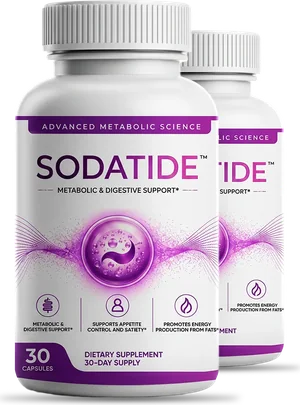
Label reading
How to Read a Probiotic Label: CFU, Strain Codes and Blends, Using Sodatide as the Example
Look for four things: the full name of each strain with its code, a live count (CFU) that holds until the best-before date, an amount per strain, and storage directions. Weight in milligrams is not a live count (NIH ODS, Probiotics (health professional)). The Sodatide label names three species in a 36 mg blend but prints no CFU, no strain codes and no per-strain amounts.
Written by the Sodatide editorial teamUpdated · 9 min read

The checklist
What should a probiotic label tell you?
A good probiotic label answers three questions: which bacteria, how many are alive, and how to keep them alive.
Bacteria are named in three parts: genus (Bifidobacterium), species (infantis), then a strain code. Studies are done on strains, so the code lets you match a bottle to a trial.
| Look for | Why it matters |
|---|---|
| Genus and species | Tells you the type of bacteria |
| Strain code | Lets you find the study done on that exact strain |
| CFU (live count) | The dose that matters; weight is not a count (NIH ODS, Probiotics (health professional)) |
| Amount per strain | Shows whether each strain is near a studied dose |
| Best-before date | Live counts can drop over time |
| Storage line | Heat and moisture can harm live cultures |
Live count
What does CFU mean on a probiotic label?
CFU stands for colony-forming units, a lab estimate of how many cells in a dose can grow. Many products hold 1 to 10 billion CFU per dose (NIH ODS, Probiotics (health professional)).
Milligrams measure weight instead. The NIH says label weight has no relationship with the number of live microorganisms (NIH ODS, Probiotics (health professional)). A label that lists only weight cannot be compared with any study dose.
The best wording is a count "through the best-before date". A count "at manufacture" tells you what went in, not what reaches you.
Some newer products use pasteurized bacteria, heat-treated so they no longer grow. If a label does not say live or pasteurized, you cannot tell which form you are buying.
Strain codes
Why do strain codes matter on a probiotic?
Strain codes matter because two strains of the same species can act differently. Results from one strain do not carry over to another one by default.
A real example makes the point. In a trial of 362 women with IBS, Bifidobacterium infantis 35624 helped pain and bloating at 100 million CFU a day. Higher and lower doses did not beat placebo (Whorwell 2006 (B. infantis 35624, IBS)). That finding means nothing for a bottle unless you know both its strain code and its count.
- Code present: you can search for studies on that exact strain.
- Code missing: you only know the species, which is like knowing a car's brand but not its model.
Worked example
How do you read the Sodatide label, line by line?
The full label, unrolled flat, and the checklist applied to it.
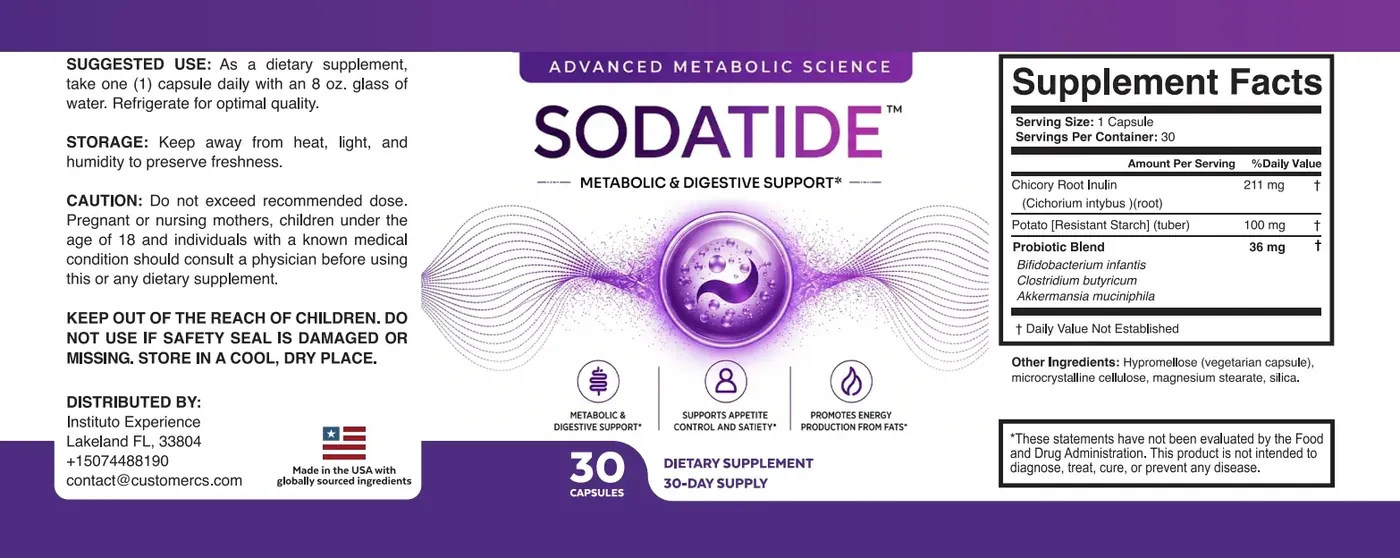
Start on the right side of the label, not the front. The Supplement Facts panel shows a serving of 1 capsule with two fibers and a 36 mg Probiotic Blend.
| Checklist item | What the Sodatide label shows |
|---|---|
| Genus and species | Yes, all three named |
| Strain codes | Not published |
| CFU (live count) | Not published |
| Amount per strain | Not published (36 mg total for the blend) |
| Live or pasteurized | Not published |
| Best-before date | Not shown in any image we have |
| Storage | "Refrigerate for optimal quality" and "store in a cool, dry place" |
To be fair, both fiber lines carry real amounts. The gaps are all on the bacteria side. More detail on each strain lives on our Akkermansia page and the B. infantis page.
Fine print
What is a proprietary blend on a supplement label?
A proprietary blend is a group of ingredients listed under one name with one total weight. U.S. rules let the maker show only the blend's total weight, with the ingredients listed in order of weight (21 CFR 101.36 (proprietary blends)). So "Probiotic Blend 36 mg" is legal even with no per-strain amounts.
Order still hints at something. If the rule is followed, B. infantis, listed first, is the largest share by weight. Weight is still not live count.
A quick test for the store aisle: cover the blend's name with your thumb. If no number is left next to any single strain, you are buying on trust.
Study doses
How many CFU did probiotic studies use?
Fiber and probiotic doses from the linked trials, drawn to scale.
Fiber doses come from the linked trials (Jackson 1999 (inulin 10 g/day)) (Bush 2023 (resistant potato starch)); probiotic doses from (Whorwell 2006 (B. infantis 35624, IBS)) (NIH ODS, Probiotics (health professional)) (Depommier 2019 (Akkermansia pilot)) (UK ACNFP 2024 (pasteurised Akkermansia)). Sodatide prints no CFU count, so it cannot be placed on the second chart. Its 36 mg blend is a weight, and weight says nothing about live count.
The lower chart spans a 500-fold range, from 0.1 to 50 billion a day. Without a number, a product cannot be placed anywhere on it.
Claims
What do the asterisks and the FDA box mean?
An asterisk after a claim points to the standard FDA box: the statement has not been evaluated, and the product is not meant to diagnose, treat or prevent any disease.
The Sodatide front panel claims metabolic and digestive support, appetite control and satiety, and energy from fats. Those are claims, not test results. The sales page goes much further than the label, which we cover in our post on GLP-1 claims.
Read first
Supplement Facts, caution and storage.
Read last
Front claims and badges.
Your next step
What should you ask the seller before you buy?
Ask for the CFU count
Ask for the live count per capsule at the best-before date, for each strain if possible.
Ask for the strain codes
Ask which strain of each species is used, so you can look up its studies.
Ask live or pasteurized
This matters most for Akkermansia, where the pilot tested both forms.
Ask about storage
Ask whether the fridge is required or just better.
For Sodatide, call +1 (302) 200-3480. The full label is typed out on the Sodatide Supplement Facts page.
Sources
Sources for this article
- 21 CFR 101.36: Nutrition labeling of dietary supplements. eCFR / U.S. Food and Drug Administration, current.Under 101.36(c), blend ingredients are listed in descending order of predominance by weight and only "the total weight of all other dietary ingredients contained in the proprietary blend" must be declared, so per-strain amounts are not required.
- Probiotics: Fact Sheet for Health Professionals. NIH Office of Dietary Supplements, current page.Label weight "has no relationship with the number of viable microorganisms in the product"; many products contain 1 to 10 billion CFU per dose. Probiotics are "unlikely to cause harm in healthy people" but may harm people who are severely ill or immunocompromised; one review found a 0.82 cm waist reduction and no effect on body weight or BMI.
- Efficacy of an encapsulated probiotic Bifidobacterium infantis 35624 in women with irritable bowel syndrome. Whorwell PJ, et al. American Journal of Gastroenterology, 2006.362 women with IBS, 4 weeks; only the 1x10^8 cfu dose beat placebo on abdominal pain and other symptoms (global improvement more than 20% over placebo); 10^6 and 10^10 doses did not; no significant adverse events.
FAQ
Probiotic label questions
What is a good CFU count for a probiotic?
There is no single good number. Many products hold 1 to 10 billion CFU per dose, but the right count depends on the strain and what was studied. One B. infantis trial worked best at 100 million a day, so match the count to the strain's own research.
Is mg the same as CFU on a probiotic label?
No. Milligrams measure weight, and CFU estimates live cells that can grow. The NIH says label weight has no relationship with the number of live microorganisms. A 36 mg blend, like the one in Sodatide, could hold many cells or few.
How many CFU are in Sodatide?
The label does not say. Sodatide lists a 36 mg Probiotic Blend with three species and no CFU count, strain codes or per-strain amounts. Ask the order desk for it before you order.
Why do probiotic labels list strain codes?
Strain codes link a product to the studies done on that exact strain. Two strains of the same species can act differently, so results do not transfer by default.
Are proprietary blends bad on supplements?
They are legal, but they hide detail. U.S. rules require only the blend's total weight, so you cannot see how much of each ingredient you get. For probiotics that matters, because the dose that counts is a live count, not a weight.
Who wrote this
Written and reviewed by
Plain-language pages built from the Sodatide label, the sales page and linked public health sources such as NIH, FDA and the FTC.
Last updated . See our editorial standards and how we check reviews. This website is run by Sodatideroutine, a USA authorized Sodatide retailer, not by the manufacturer. This site earns a commission when you buy through our order links.
Keep reading
More about Sodatide
Supplement Facts
The whole Sodatide label typed out word for word, with what each line tells you and what it leaves out.
Read moreChoosing a probiotic
Strain codes, CFU counts, storage and safety: what to check on any probiotic label before you buy.
Read moreAkkermansia muciniphila
The gut bacterium social media loves: what Sodatide's label shows, what the one pilot trial found, and what is missing.
Read moreUSA Authorized Sodatide Retailer
Ready to try Sodatide?
Pick a pack, read the label, and keep your order email. One capsule a day; every pack outlasts the first 30 days the guarantee asks for.
- Secure checkout
- 60-day money-back window
- Tracking in the order email